
Secure Your Business & Gain a Competitive Edge
In 2026, the digital landscape has never been more sophisticated—or more volatile. As businesses lean deeper into AI-driven operations and hyper-connected networks, the fear of a data breach isn’t just paranoia; it’s a pragmatic concern. Relying on outdated security measures is no longer an option. A professional it infrastructure audit checklist is your first line of defense, transforming your IT from a hidden liability into a transparent, fortified asset. By utilizing professional cyber security audit services, you aren’t just checking boxes; you are ensuring your business remains resilient against evolving threats.
Decoding the IT Audit Process
Understanding the audit process shouldn’t feel like staring into a black box. A structured approach ensures that no stone is left unturned, from your local hardware to your furthest cloud node.
How to perform a security audit and testing?
A successful security audit begins with a comprehensive vulnerability assessment. This involves using automated tools to scan for known weaknesses, followed by manual penetration testing to see how those vulnerabilities could be exploited in the real world. The goal is to simulate a breach before a malicious actor does it for you.
Understanding the 5 stages of a professional audit process
Most high-level internal audits follow a rigorous five-stage lifecycle:
- Planning: Defining the scope, identifying key assets, and setting objectives.
- Fieldwork: The data collection phase where configurations, logs, and policies are reviewed.
- Analysis: Evaluating the gathered data against industry benchmarks and security standards.
- Reporting: Documenting findings and prioritizing risks.
- Follow-up: Verifying that remediation steps have been successfully implemented.
Navigating Regulatory Compliance in Australia
For Australian businesses, regulatory compliance in Australia is no longer a “nice to have”—it is a legal imperative. With the recent tightening of the Privacy Act and the Essential Eight framework, staying compliant is central to operational continuity.
Meeting industry-specific compliance requirements
Depending on your sector—be it fintech, healthcare, or retail—your industry regulatory compliance needs will vary. Beyond standard audits, a robust Information Governance Framework is essential for long-term data integrity and legal protection.
How to write an internal audit report for ISO 27001?
To meet compliance requirements for ISO 27001, your report must be objective and evidence-based. It should clearly map your current controls against the ISO Annex A requirements, identify any “non-conformities,” and provide a clear Statement of Applicability (SoA).
Smart Systems Integration & Maintenance
Security is the shield, but efficiency is the engine. Smart systems integration ensures that your various software and hardware components “talk” to each other without creating security gaps or performance bottlenecks.
What is a monthly checklist for IT maintenance?
Regular system integration checks prevent “configuration drift.” Your monthly routine should include:
- Reviewing automated backup logs.
- Patching OS and third-party software vulnerabilities.
- Auditing user access levels (removing “ghost” accounts).
- Testing UPS systems and hardware temperature sensors.
The Master Audit Checklist
Use this network security audit guide to evaluate your current posture.
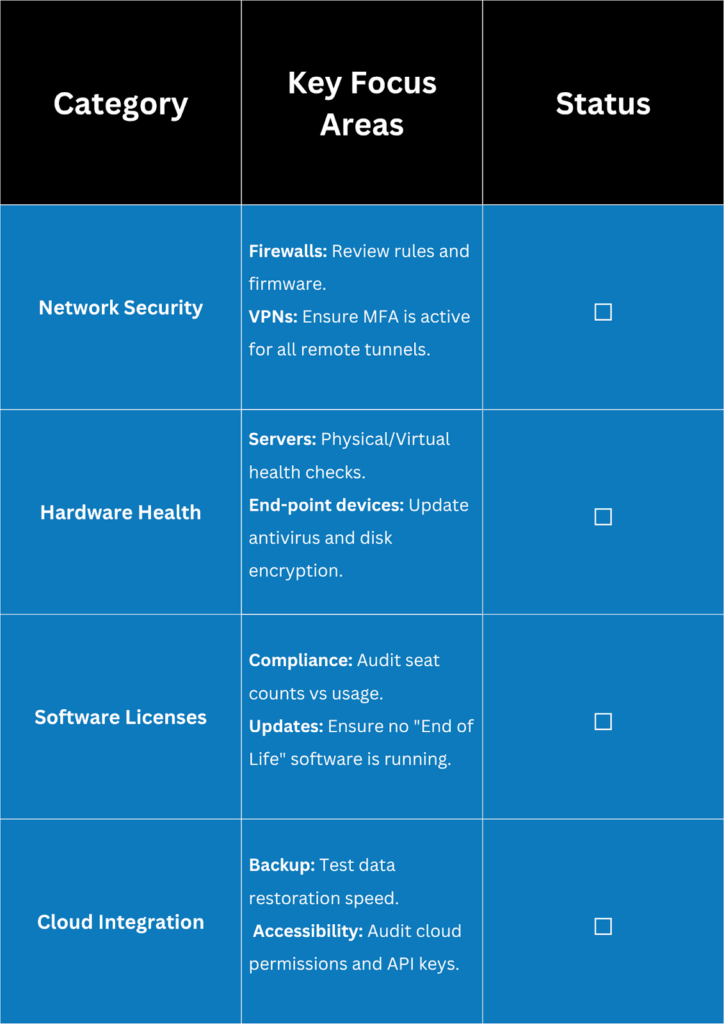
Why Audits Provide a Sustainable Competitive Edge
In a marketplace where data privacy is a top consumer priority, security is a powerful marketing tool. A sustainable competitive edge is built on trust. When you can prove your infrastructure is audited and secure, you reduce friction in B2B contracts and build brand loyalty with customers who know their data is safe. A secure business is a trusted business, and in 2026, trust is the ultimate currency.
FAQ
A security audit is a systematic evaluation of your IT infrastructure to ensure it adheres to specific security policies and standards. They are essential for identifying hidden vulnerabilities, preventing data breaches, and ensuring your security measures are actually effective against modern threats.
Australian businesses typically need to align with the ASD Essential Eight and, depending on the industry, ISO 27001 or CPS 234. This requires documented policies, regular risk assessments, and a verifiable audit trail of how data is accessed and protected.
Don’t wait for a breach to happen. Book your free consultation with Anno Tech’s audit experts today and secure your digital future. Explore our Cyber Security Services to learn more about how we can protect your growth.
For further information on national standards, visit Cyber.gov.au.